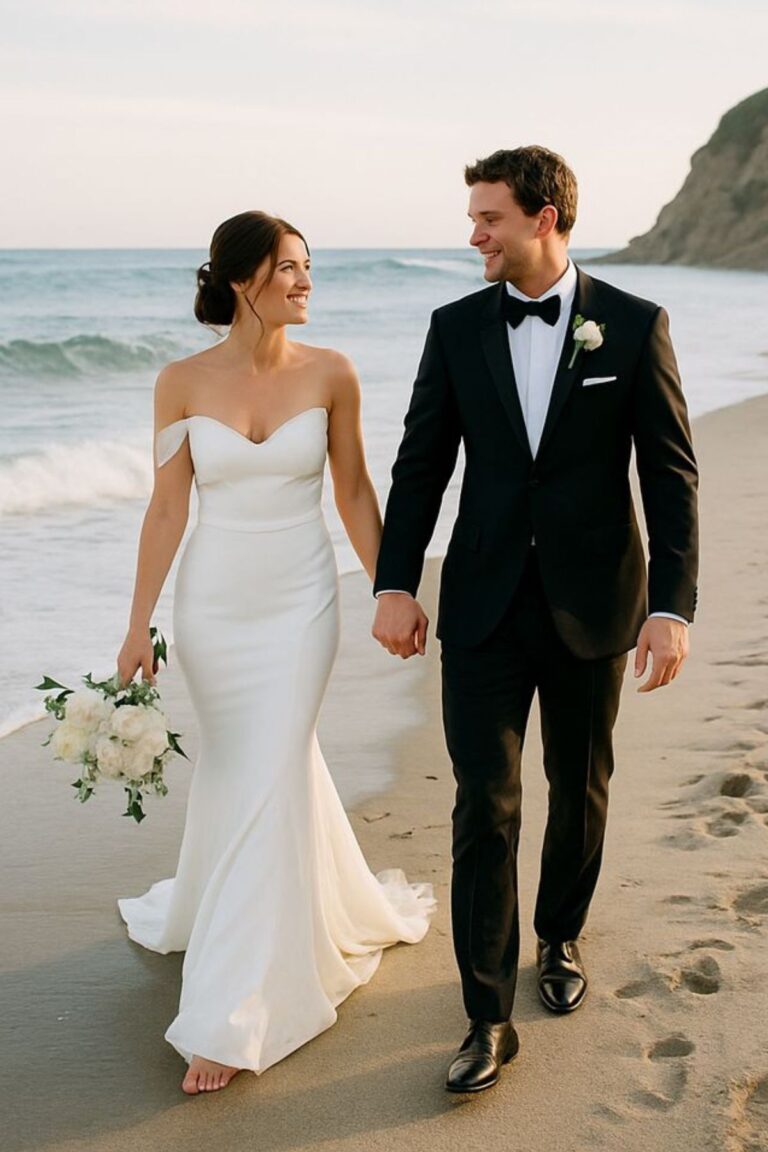

35 Poses Every Couple Should Try On Their Wedding Day
Disclosure: Some of the links in this post are affiliate links. This means if you click on the link and purchase an item, I will receive an affiliate commission at no extra cost to you.
Wedding photos preserve the little moments you may forget, and poses every couple should try can make those memories feel alive. You do not need to become professional models, because natural direction can help you look relaxed and connected.
With the right ideas, your photographer can capture genuine emotion while still giving you beautiful, polished portraits. Your wedding day moves quickly, so having a few favorite poses can keep photo time organized.
Here are 35 Poses Every Couple Should Try On Their Wedding Day for a gallery you will love revisiting.
35 Poses Every Couple Should Try On Their Wedding Day
1. The Classic Face-To-Face Pose

The classic face-to-face pose deserves a place in your wedding album because it creates an intimate portrait.
Stand close together and turn your bodies slightly toward each other for a relaxed silhouette. You can hold hands, place your arms around each other, or simply let your hands rest naturally.
Instead of staring directly into the camera, look at each other for several photographs. That simple change can soften your expressions and create a more emotional image.
Your photographer can then ask you to look toward the camera for another version.
Keep your shoulders relaxed, because tense shoulders can make even happy couples appear uncomfortable.
You can also lean slightly toward each other, which creates a natural sense of closeness.
If your photographer gives posing directions, follow them loosely rather than worrying about every movement.
This pose works beautifully almost anywhere, including outside your venue, beside a garden, or near your ceremony space.
Among the poses every couple should try, this one gives you a dependable portrait that never feels dated.
2. The Forehead Kiss

The forehead kiss creates a sweet photograph without requiring an exaggerated romantic pose.
Have one partner gently kiss the other’s forehead while standing close together. The person receiving the kiss can look down, close their eyes, or smile softly toward the camera.
You do not need to force a serious expression because genuine emotion photographs beautifully.
Think about the person standing beside you and allow your expression to respond naturally. That small shift can make the photograph feel personal rather than carefully rehearsed.
Ask your photographer to capture several angles while you hold the pose. A close portrait can emphasize your expressions, while a wider photograph can show your outfits.
You can also try this pose outdoors, especially when your venue has attractive architecture or greenery.
For another variation, hold hands while sharing the forehead kiss. You can also place one hand gently around your partner’s waist or shoulder.
Small movements can give your photographer several photographs without requiring another setup.
This idea belongs among the poses every couple should try because it feels affectionate without becoming overly dramatic.
3. The Walking Hand-In-Hand Pose

Walking photographs can help you forget about the camera while giving your photographer natural movement.
Hold hands and walk slowly together while looking at each other or toward your surroundings.
Your photographer can walk backward or position themselves ahead of you for several different perspectives.
Do not rush the walk, because a slower pace gives you time to interact naturally. You can talk quietly, smile, laugh, or pretend you are walking away after saying something funny.
Those small interactions often create expressions that look far more natural than a forced smile.
Your photographer can also ask you to walk toward the camera together. Try looking at each other for one photograph, then look ahead for another version.
You can also turn slightly toward your partner while continuing to walk.
This pose works particularly well with flowing dresses, long veils, and wedding suits. Your photographer can capture movement in the fabric while keeping your relationship at the center.
Choose a clean pathway so your photographer can work without guests or decorations distracting from you.
Among the poses every couple should try, walking portraits offer plenty of room for personality. They can feel playful, romantic, elegant, or completely relaxed depending on your expressions.
4. The Looking-Over-The-Shoulder Pose
Turn slightly away from your partner while looking back over your shoulder. Your partner can stand close behind you, with one hand resting gently around your waist.
You can also hold hands behind you, which creates a softer and more connected photograph. Keep your shoulders relaxed so the pose feels effortless rather than carefully arranged.
This pose works especially well when your wedding dress has beautiful back details, such as buttons, lace, an open back, or a long train.
Your photographer can capture those details while keeping your face visible. If you are wearing a veil, ask your photographer to capture a version with the veil flowing behind you.
Try several expressions instead of holding one smile throughout the session.
You can give your partner a playful glance, smile toward the camera, or look away as though you just heard something funny.
Your photographer can also ask your partner to look at you instead of the camera.
For a more romantic photograph, move slightly closer together and let your partner rest their forehead near your temple. You can then look toward the camera while your partner looks at you.
Small changes like this can create several photographs without requiring a completely new setup.
Among the poses every couple should try, this one gives you an elegant portrait with very little effort.
5. The Nose-To-Nose Pose

Stand close together and gently bring your noses near each other while facing one another.
You do not need to press your faces together, because a small amount of space can make the pose look more natural. Hold hands or place one arm around your partner for an added sense of closeness.
Start with both of you looking at each other, then try closing your eyes for another photograph. You can also smile slightly instead of maintaining a serious expression.
If you naturally start laughing, keep going because those unscripted reactions can produce some of your favorite wedding pictures.
Your photographer can capture this pose from several distances. A close photograph can focus on your expressions, while a wider frame can show your outfits and surroundings.
You can also angle your bodies slightly toward the camera, which helps create a more flattering composition.
This pose works beautifully during outdoor portraits, especially when you have soft evening light. It can also look lovely inside your venue near a large window.
The important part involves staying comfortable and allowing the moment to feel like something you would naturally do together.
For couples who feel awkward with dramatic posing, this option offers a simple alternative. It gives your photographer a clear starting position while leaving plenty of room for genuine expressions.
6. The Cheek Kiss
Give your partner a gentle kiss on the cheek while they look toward the camera. Keep the kiss brief and natural, then hold the position for a moment while your photographer captures the frame.
Afterward, switch positions so your photographer can capture the same idea from the other side.
You can make this pose playful by smiling immediately after the kiss. If your partner starts laughing, allow the moment to continue instead of returning to a serious expression.
Those reactions can give your photographer several candid-looking images without changing your location.
Your hands can also create different versions of the pose. Hold your partner’s hand, place an arm around their waist, or gently touch their shoulder.
Avoid worrying about placing every finger perfectly, because relaxed hands usually look much more natural.
The cheek kiss works particularly well for couples who want affectionate photographs without overly romantic posing.
It can also work nicely with parents, grandparents, or wedding party portraits when you need a softer variation.
Consider taking this photograph both before and after the ceremony. Before the ceremony, you may capture anticipation and excitement.
Afterward, you can capture the happiness that comes with officially becoming newlyweds.
Among the poses every couple should try, this one gives you plenty of room for personality. You can make it sweet, playful, emotional, or completely spontaneous.
7. The Behind-The-Back Hug

Stand behind your partner and wrap your arms gently around their waist. Your partner can place their hands over yours while looking toward the camera.
You can also turn your head toward each other, which creates a more intimate variation.
Keep the embrace comfortable rather than holding your partner too tightly. Your shoulders should remain relaxed, and your hands should rest naturally.
If your wedding dress has details at the waist or back, this position can also help showcase them.
Ask your photographer to capture several versions while you remain in the same position. Start with both people looking toward the camera, then have one person look at the other.
You can also whisper something funny, which may produce a genuine laugh.
This pose looks particularly beautiful outdoors, especially in gardens, courtyards, and areas with soft evening light. It can also work inside your reception venue if you have a clean background.
Your photographer can move around you instead of making you repeatedly change positions.
You can create another variation by standing slightly apart before the hug. Then slowly move closer while your photographer captures the interaction.
This approach can produce a sequence of photographs that feels like a natural moment instead of a fixed pose.
8. The Walking And Laughing Pose
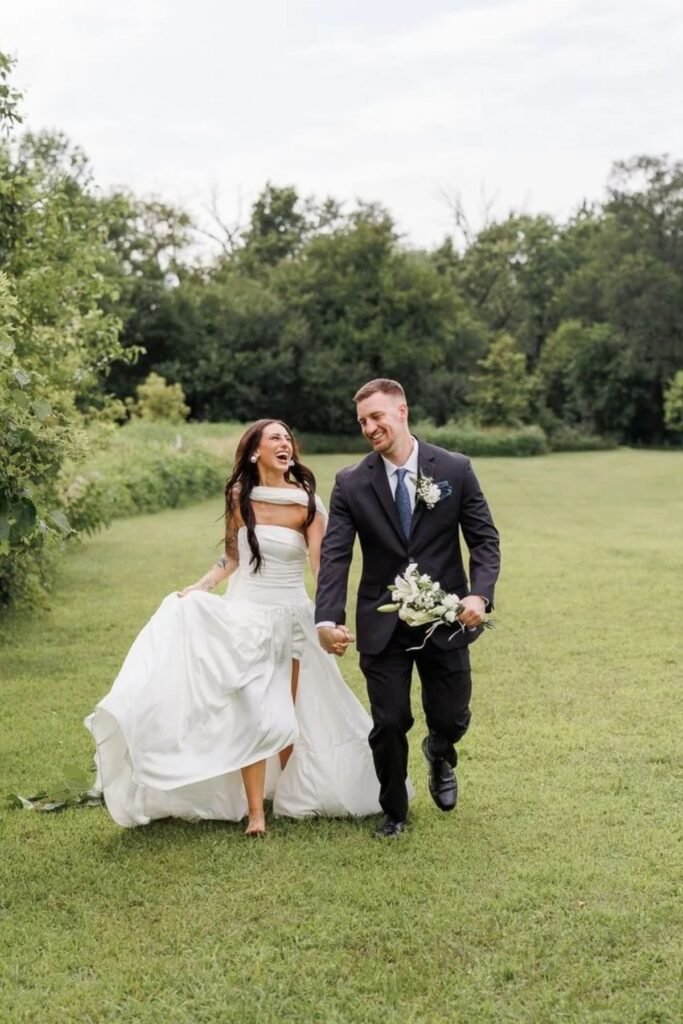
Walk together while pretending to share a funny secret or private joke. Hold hands and move slowly so your photographer can capture several frames.
You can talk quietly, smile at each other, or laugh about something that happened earlier during the wedding.
The key involves keeping your movement natural rather than trying to create a perfect walking photograph.
Take small steps and avoid looking directly at the camera the entire time. Your photographer can capture you from the front, side, or slightly behind as you move.
You can also change your hand positions during the walk. Hold hands for one photograph, then place an arm around your partner for another.
If your dress has a long train, walking can create beautiful movement that adds life to the images.
Try walking through several different parts of your venue if time allows. A garden path, grand hallway, staircase, or outdoor courtyard can give each photograph a different appearance.
Your photographer can also use different lenses to create both intimate and wider compositions.
This pose works particularly well for couples who feel uncomfortable standing still. Movement gives you something to focus on, so you may stop thinking about the camera.
Your genuine laughter can then become the most memorable part of the photograph.
9. The Veil Portrait
Stand together beneath your wedding veil while facing the camera or looking toward each other. Your photographer can gently arrange the veil around your shoulders before taking the photograph.
The veil can create a soft frame around your faces while adding another layer of visual interest.
Start with a traditional portrait where both of you look at the camera. Then turn toward each other and allow your expressions to change naturally.
You can also hold hands beneath the veil, which brings your rings into the composition.
If your veil is long, ask your photographer to capture a wider photograph. This can show the full length of the veil while keeping both of you visible.
A closer photograph can then focus on your faces and the small details of your outfits.
Wind can also create beautiful movement if you are taking photographs outdoors. Your photographer may position you where a gentle breeze can lift the veil naturally.
Avoid forcing the fabric into dramatic movement, because natural motion usually looks more convincing.
You can also create a playful variation by hiding slightly beneath the veil together. Look at each other, smile, or share a quiet laugh before the photographer captures the moment.
This version can feel less formal while still looking beautiful.
10. The Ring-Focused Pose

Bring your hands together so your wedding rings become part of the photograph.
Your photographer can focus closely on your hands while keeping portions of your outfits visible. You can hold hands, intertwine your fingers, or place your hands around the bouquet.
This photograph works particularly well immediately after the ceremony.
Your rings are new, your emotions are still fresh, and the meaning behind the moment remains strong. Your photographer can capture the rings without interrupting the flow of your portrait session.
Try placing your hands against a simple background so the rings remain easy to see. Your bouquet can provide a beautiful setting, especially if its colors complement your wedding attire.
You can also place your hands against your partner’s jacket or suit for another variation.
Keep your fingers relaxed instead of spreading them widely for the camera. Small details such as your manicure, bouquet, watch, cufflinks, or wedding attire can also appear naturally.
Ask your photographer for both close-up and wider versions.
You can create a more emotional photograph by holding hands while looking at each other. Your hands become part of the story instead of appearing as an isolated detail.
This approach also gives you a photograph that connects the rings with the people wearing them.
11. The Forehead-To-Forehead Pose

Stand close and gently rest your foreheads together while facing each other. You can look into each other’s eyes, close your eyes, or smile softly.
The pose creates a quiet moment that can contrast beautifully with the excitement surrounding your wedding day.
Hold hands while standing in this position if you want a stronger sense of connection. You can also place one hand around your partner’s waist.
Keep your arms relaxed, because the photograph should feel like a genuine moment rather than a carefully arranged pose.
Ask your photographer to capture several expressions without moving you into a new position. Start with a serious expression, then smile naturally at each other.
If one of you starts laughing, allow the laughter to continue instead of resetting the pose.
This idea works well indoors and outdoors. You can take the photograph beneath an arch, beside a window, in a garden, or against a clean reception backdrop.
Your photographer can also use close framing to keep the background soft and place attention on your faces.
For a slightly different composition, turn your bodies toward the camera while keeping your foreheads together.
This allows your photographer to show more of your wedding attire. You can then return to the original position for a closer portrait.
These poses every couple should try can create photographs that feel calm and intimate.
12. The First Dance Pose

Recreate a small part of your first dance during your portrait session.
Hold each other comfortably and sway slowly while your photographer captures the interaction. You can look into each other’s eyes or occasionally glance toward the camera.
You do not need to perform your entire wedding dance. A few slow movements can give your photographer enough opportunities to capture natural expressions.
If you have a favorite song, playing it quietly can help you relax and return to the emotion of the moment.
Try several variations while maintaining the same basic position.
You can face each other, turn slightly toward the camera, or move together across the floor. Your photographer can capture both close portraits and wider images showing the venue.
If your dress has movement, gentle dancing can also show how the fabric flows. Your partner’s suit or jacket can move naturally as well.
Those small details can make your photographs feel energetic without requiring dramatic choreography.
You can even include a small spin if your attire allows comfortable movement. Ask your photographer to capture the moment before, during, and after the turn.
This creates a sequence that feels like a real memory rather than a single posed photograph.
13. The Spin Pose

Have one partner gently spin the other while the photographer captures the movement.
Keep the turn slow and controlled, especially if the bride is wearing a long dress or carrying a bouquet. Your photographer can capture the flowing fabric while keeping your faces visible.
Start with a simple turn before trying anything more playful. Look at each other during the movement, then try looking toward the camera.
You can also smile or laugh when the spin finishes, giving your photographer another natural frame.
Your photographer should choose enough space for the movement. Clear the area of chairs, decorations, bags, and other objects that could interfere.
Good lighting also helps because movement can become harder to capture in very dark spaces.
This pose can work beautifully outdoors because natural light often makes moving fabric easier to photograph.
It can also work inside a reception venue with enough open floor space. Your photographer can change their position instead of asking you to repeat the movement too many times.
If spinning makes you uncomfortable, skip it without hesitation.
You can create a similar effect by walking slowly while your partner gently turns you. Comfort should always take priority over copying a particular wedding photograph.
This belongs among the poses every couple should try because it introduces movement and playfulness into a formal portrait session.
14. The Back-To-Back Pose
Stand back-to-back while keeping your shoulders relaxed and your feet comfortable.
You can look in opposite directions or turn your heads slightly toward each other. This creates a stylish composition while giving you a break from facing the camera together.
For a formal version, stand tall and keep your expressions calm.
For something more playful, smile at each other over your shoulders. You can also place your hands in your pockets, hold your bouquet, or link one arm with your partner.
This pose works particularly well when your wedding attire deserves attention.
Your photographer can show different details on both outfits within the same frame. A wide photograph can reveal your full clothing, while a closer image can focus on your expressions.
Try using an architectural background for this pose.
A grand staircase, doorway, textured wall, or clean outdoor structure can create strong lines around your bodies. Keep the background simple enough so it does not distract from the two of you.
You can also create a softer version by standing slightly apart.
Leave a small amount of space between your backs, then turn your heads toward one another. This gives the photograph a more relaxed appearance.
15. The Sitting Together Pose

Find a comfortable bench, staircase, chair, low wall, or other suitable spot where you can sit together.
Angle your bodies slightly toward each other instead of sitting completely straight. This creates a relaxed composition that differs from standing portraits.
You can hold hands, lean gently against your partner, or place an arm around their shoulder.
Look toward the camera for one photograph, then look at each other for another. A quiet conversation can also help your expressions feel natural.
Pay attention to your wedding clothing before sitting down.
A long dress may need careful arrangement, while a suit may need a quick jacket adjustment. Your photographer or assistant can help arrange the fabric before taking the photograph.
Staircases can create particularly attractive compositions because they add different heights to the image.
A bench can produce a more intimate portrait, while a wide outdoor step can create a casual appearance. Choose the setting based on the style you want.
You can also ask your photographer to photograph your hands while you sit together.
This can bring your rings and bouquet into the same image. Small details often become more meaningful when they appear naturally within a larger portrait.
16. The Staircase Portrait
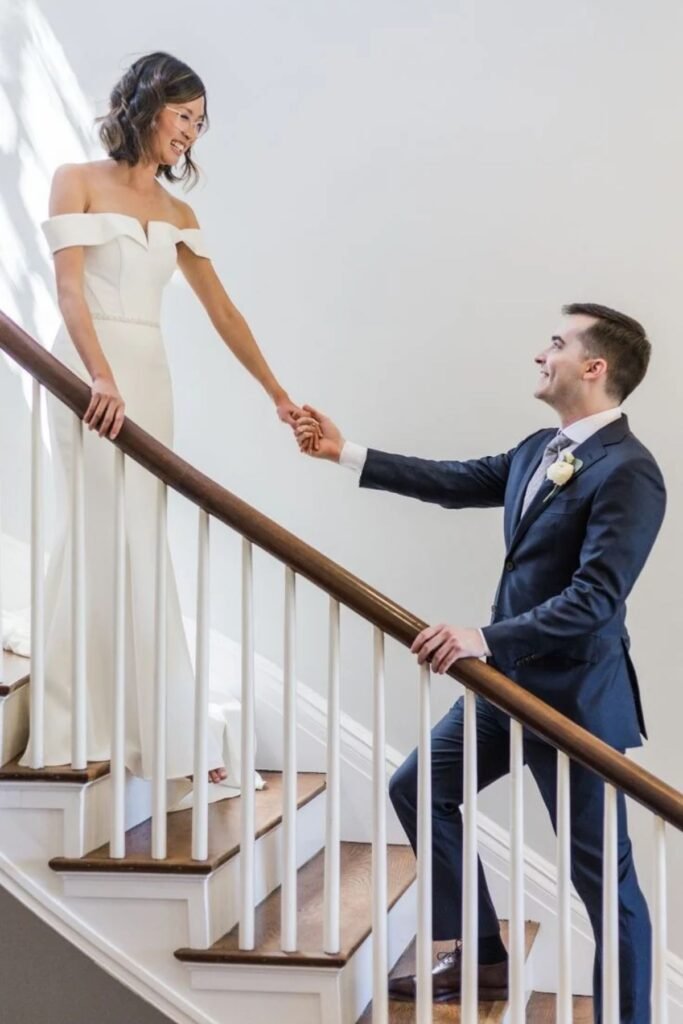
Use your venue’s staircase to create a portrait with height, depth, and strong architectural lines.
You can stand together on the same step or position yourselves a few steps apart. Your photographer can shoot from below, above, or directly in front.
If the bride has a long train, arrange it carefully across the steps before taking the photograph.
A flowing train can add beautiful movement to the composition. Your photographer can also capture a wider frame that shows the full length of the dress.
Hold hands for a traditional photograph, then try standing close with one arm around your partner.
You can also face each other instead of looking at the camera. These small changes can produce several different images without moving to another location.
Pay attention to your posture because stairs can make people lean awkwardly.
Keep your shoulders relaxed and distribute your weight comfortably. If your shoes make the steps difficult, choose a lower position that feels secure.
A staircase also gives you an opportunity to create a more editorial portrait.
Your photographer can use the lines of the steps to guide the viewer’s attention toward you. Keep decorations and background objects organized so the composition remains clean.
17. The Bouquet Together Pose
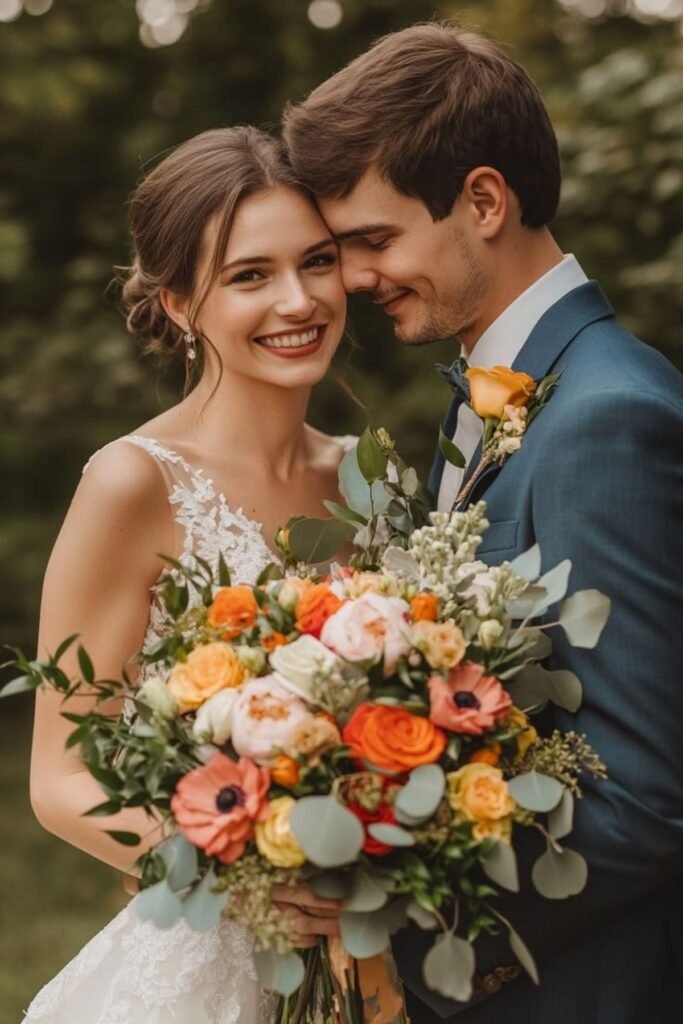
Hold your wedding bouquet together while standing close to each other.
One partner can hold the flowers while the other gently places a hand over theirs. You can look toward the camera, look at each other, or glance down at the bouquet.
This pose gives your hands something natural to do, which can help if you feel awkward during portraits.
It also brings your flowers into the photograph without allowing them to dominate the composition. Your photographer can adjust the bouquet slightly to keep both faces visible.
Try a close-up that includes your hands, rings, and flowers.
Then step back for a wider portrait that shows your complete outfits. These two photographs can feel completely different despite using the same basic pose.
You can also hold the bouquet between you while standing forehead-to-forehead.
Another option involves placing the flowers slightly to one side while you hold hands with your free hands. Small changes can give your photographer several compositions.
Consider taking this photograph soon after the ceremony.
Your bouquet will still look fresh, and you can capture it alongside your wedding rings. If your flowers contain meaningful colors or specific blooms, this portrait can preserve those details beautifully.
18. The Almost-Kiss Pose
Stand close together and pause just before sharing a kiss.
You can close your eyes, smile softly, or look directly at each other. Your photographer can capture the anticipation without requiring a dramatic pose.
Keep the moment brief because holding an almost-kiss for too long can start feeling awkward.
Take a breath, move close, pause, and let your photographer capture the frame. You can then share the actual kiss for another photograph.
This pose works particularly well during sunset portraits.
Soft evening light can create a romantic atmosphere while keeping your expressions visible. Your photographer can also position you against a simple background to keep attention on the two of you.
Try holding hands during the pose if you want a little extra connection.
You can also place one hand gently around your partner’s waist. Avoid forcing your hands into complicated positions because simple gestures usually photograph better.
You can create another version by standing slightly apart before slowly moving closer.
Your photographer can capture the movement and anticipation as you approach each other. This can produce several natural frames without requiring you to hold a fixed position.
19. The Shoulder Lean
Lean your head gently against your partner’s shoulder while standing together.
Your partner can place an arm around you or hold your hand. Look toward the camera for a classic portrait, then turn toward each other for a softer version.
This pose works well for couples who prefer understated photographs.
It creates closeness without requiring dramatic gestures or complicated movement. You can also use it during a quiet moment between larger group photographs.
Your photographer can capture the pose at several distances.
A close photograph can focus on your expressions, while a wider frame can show your wedding outfits and surroundings. Try both so your gallery contains different compositions.
You can also reverse the position if both partners feel comfortable.
One photograph can show the bride leaning on the groom, while another can show the groom leaning toward the bride. This creates variety while keeping the same simple setup.
A shoulder lean works particularly well near windows, gardens, trees, and simple architectural backgrounds.
Choose a location where you can stand comfortably without worrying about guests moving behind you. A clean background can help your expressions remain the focus.
20. The Looking-At-The-Camera Pose
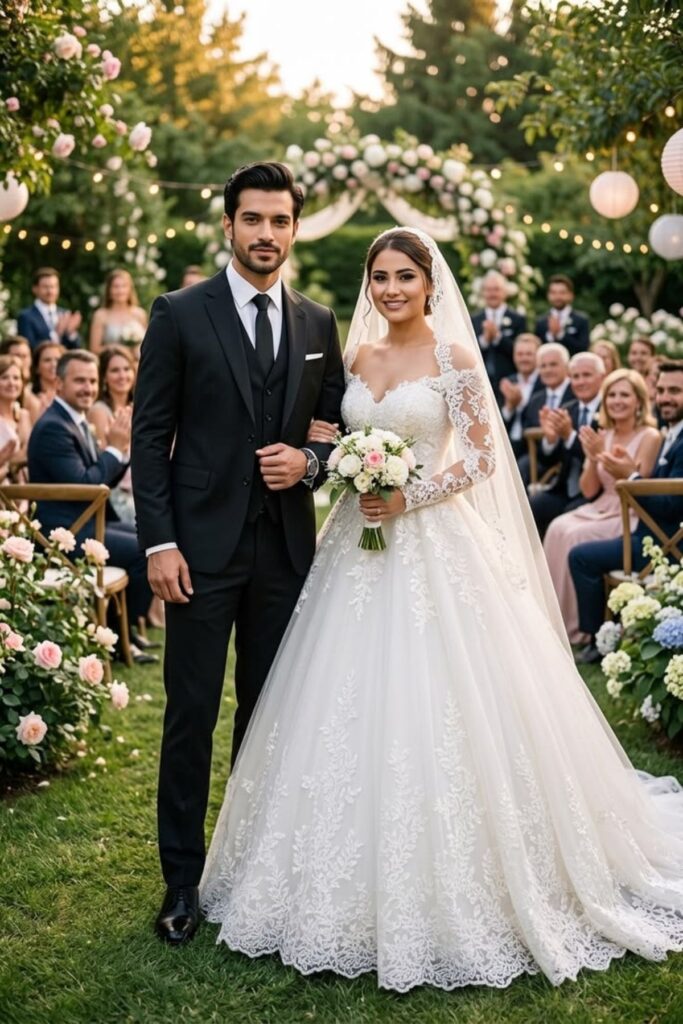
Stand close together and look directly into the camera for a classic wedding portrait.
Angle your bodies slightly instead of standing completely straight. This small adjustment can create a more relaxed appearance while keeping the photograph polished.
You can hold hands, place one arm around your partner, or let your hands rest naturally.
If you have a bouquet, position it slightly to one side so both faces remain visible. Your photographer can help you adjust small details before taking the photograph.
Try several expressions rather than keeping the same smile for every frame.
Start with a gentle smile, then try a slightly bigger smile or a relaxed expression. You can also laugh together before returning your attention to the camera.
This pose works almost anywhere, which makes it especially useful during a busy wedding day.
You can take it outside the ceremony venue, inside the reception space, near a staircase, or beside your wedding backdrop.
Your photographer can also create different compositions without moving you.
A full-body photograph can show your complete outfits, while a waist-up portrait can focus on your faces and upper-body details. A close-up can then highlight your expressions and rings.
21. The Partner Adjusting The Tie Pose
Have one partner gently adjust the other’s tie, bow tie, collar, or jacket.
This creates a natural interaction while giving your hands something useful to do. The partner being helped can watch with a soft smile or look toward the camera.
You can take this photograph before the ceremony while everyone prepares.
However, it can also work beautifully after the ceremony when your outfits are complete. Your photographer can capture the small details while keeping your relationship at the center.
Try several versions without changing your location.
Look at each other for one photograph, then look toward the camera. You can also laugh together after the adjustment, which may create a more relaxed image.
Your photographer can capture a close-up that includes your hands, cufflinks, watch, and wedding rings.
A wider photograph can then show both outfits and the surrounding venue. These variations help you get several useful photographs from one simple setup.
This pose can work especially well for couples who dislike standing still.
You have a clear action to perform, so your hands and attention have somewhere to go. You can also turn it into a playful moment by pretending the tie needs several adjustments.
22. The Dress Adjustment Pose
Ask your partner to gently adjust your veil, train, sleeve, or another detail of your wedding outfit.
Your photographer can capture the interaction as your partner helps you prepare. You can look toward them, smile at the camera, or glance down at the dress.
This pose works especially well after the ceremony when your wedding attire has already received plenty of attention.
Your photographer can use the moment to capture small details that traditional portraits might miss. It also creates a relaxed break between more formal poses.
If your dress has a long train, your partner can gently arrange it before stepping beside you.
Your photographer can capture both the adjustment and the finished arrangement. This can create a small series of photographs without requiring another location.
You can also reverse the idea by helping your partner with a jacket, cuff, boutonniere, or pocket square.
That creates balance in your wedding gallery. It also shows the simple ways you support each other throughout the day.
Try not to overthink your facial expression during this pose. Talk to each other, make a small joke, or simply smile. Your photographer can capture several frames while you interact naturally.
23. The Hand-On-Waist Pose

Stand close together while one partner places a hand gently around the other’s waist.
Angle your bodies slightly toward the camera instead of standing completely straight. This simple position creates a classic portrait without requiring complicated instructions.
Keep your shoulders relaxed and avoid pulling your partner too tightly.
Your free hands can hold a bouquet, rest naturally, or link together. If you feel unsure about what to do, holding hands usually gives the photograph a comfortable appearance.
Start with both of you looking at the camera. Then turn toward each other and smile. You can also ask your photographer to capture a moment where one partner whispers something to the other.
This pose works almost anywhere, so you can use it during different parts of your wedding portrait session.
It can look elegant outside your venue, relaxed in a garden, or polished inside your reception space.
Your photographer can also experiment with different crops.
A full-body photograph can showcase your outfits, while a closer portrait can emphasize your expressions. You can also include your hands so your wedding rings appear naturally.
24. The Partner Looking At The Bride
Have one partner face the camera while the other looks lovingly toward them.
The bride can look toward the camera while the groom watches her, creating a photograph with different directions of attention.
Keep your bodies close together so the image still feels connected. You can hold hands or place an arm around each other. Your photographer can also ask the groom to move slightly closer while maintaining his gaze.
Try several expressions during the pose. A soft smile can create an elegant photograph, while a small laugh can make the image feel more spontaneous.
You can also ask the groom to whisper something funny before looking at the bride.
This pose works especially well when the bride has a detailed dress or veil. The camera can show the dress clearly while capturing the groom’s expression.
It also creates a natural opportunity to photograph the couple without requiring both people to stare at the camera.
Your photographer can switch sides and change the framing without asking you to move much.
A wider shot can include the venue, while a closer photograph can focus on your faces. This makes the pose practical during a busy wedding timeline.
25. The Partner Looking At The Groom
Reverse the previous pose so one partner looks toward the groom while he faces the camera.
This simple change gives you a completely different photograph without requiring another location or complicated setup.
Stand close together and keep your bodies slightly angled toward the camera.
You can hold hands or place one arm around your partner’s waist. Your expressions can remain soft and natural while your photographer captures the interaction.
Try looking at your partner with a small smile rather than holding an exaggerated expression.
You can also look down briefly before looking back at them. These small movements can help your face remain relaxed during the session.
Your photographer can capture a close-up of your faces before stepping back for a wider photograph.
A wider frame can include your wedding attire and the surrounding venue. If you are outdoors, the photographer can also use the background to create a more scenic portrait.
This pose can work particularly well after you have taken several photographs facing the camera.
It gives your eyes somewhere else to go and creates a small change in the mood. You may also find yourself smiling naturally because you are looking at your partner.
26. The Walking Away Pose

Hold hands and walk away from the camera together while your photographer captures your backs.
This pose can show your wedding outfits, dress train, shoes, and the setting around you. It also gives you a natural opportunity to move after several stationary portraits.
Walk slowly instead of rushing toward your destination.
Your photographer may need several frames to capture your steps at the right moment. You can talk quietly or laugh together while continuing down the path.
Turn your heads toward each other for one photograph. Then look ahead and continue walking naturally. If your dress has a long train, your photographer can capture how it moves behind you.
Choose a location with enough space for comfortable walking.
A garden path, outdoor walkway, hallway, or venue entrance can work beautifully. Ask someone to check the area first so guests and equipment do not interrupt the photograph.
You can also create a more playful version by stopping halfway.
Turn toward each other, share a quick laugh, then continue walking. Your photographer can capture the sequence without making you return to the starting point.
27. The Looking-At-The-View Pose
Stand together while looking toward a beautiful view instead of the camera.
This pose works particularly well at outdoor venues, rooftops, gardens, waterfront locations, and scenic properties.
Your photographer can position you so the background adds atmosphere without overwhelming the photograph.
Hold hands or place an arm around your partner while looking ahead.
You can also turn slightly toward each other while keeping your bodies pointed toward the view. This creates several compositions without requiring a complete change of location.
If the setting has mountains, trees, water, architecture, or an open sky, use a wider frame.
A wider photograph can show the environment while keeping you as the main subjects. Your photographer can then take a closer version that focuses on your expressions.
Try standing quietly for a few seconds instead of forcing a smile.
Talk to each other about something happening during the wedding or simply enjoy the view. Your photographer can capture those natural expressions from a distance.
You can also create a more romantic variation by resting your head against your partner’s shoulder.
Hold hands and look outward while your photographer captures the scene. This works particularly well during evening light.
28. The Bouquet Behind-The-Back Pose

Hold your bouquet behind your back while standing close to your partner.
Your partner can look toward you while you face the camera. You can also switch positions so your partner holds something behind their back instead.
This pose creates a playful moment without requiring exaggerated movements.
Your photographer can capture your expressions while keeping the bouquet partially hidden. A small smile can make the photograph feel sweet, while a laugh can give it more personality.
You can also create a romantic variation by having your partner guess what you are holding.
Let them react naturally before revealing the bouquet. Your photographer can capture the expressions before, during, and after the reveal.
Keep your bodies close so the photograph still feels connected. You can hold hands with your free hands or place one arm around each other. Avoid hiding too much of your outfit behind the bouquet.
This pose works well outdoors and indoors because it does not depend on a particular background.
A simple wall, garden, staircase, or reception area can work. Your photographer can use different angles to keep the composition interesting.
29. The Dancing-In-The-Room Pose
Use your reception space, bridal suite, hallway, or another private area for a spontaneous dance.
Hold each other comfortably and sway together while your photographer captures the movement. You can look into each other’s eyes or simply enjoy the music.
You do not need a choreographed routine because simple movement usually looks more natural.
Play a favorite song if the location allows it. Music can help you relax and forget that someone is taking photographs.
Try a slow turn while holding hands, then return to a close dance.
Your photographer can capture the movement from several angles. A wide photograph can show the room, while a closer image can focus on your expressions.
If your wedding dress moves beautifully, let it flow naturally during the dance.
Your photographer can capture the fabric as you turn. Your partner’s jacket and other clothing details can also benefit from the movement.
This pose works particularly well after you have taken several formal portraits.
It gives you something enjoyable to do while allowing your photographer to keep shooting. You may also discover that some of the best expressions appear when you stop thinking about posing.
30. The Lift Pose

If both partners feel comfortable, try a gentle lift for a playful wedding portrait.
One partner can carefully lift the other for a brief moment while the photographer captures the reaction. Keep the movement simple, controlled, and appropriate for your outfits.
Your photographer should choose a clear area before you attempt the pose.
Wedding dresses can restrict movement, while heels and formal shoes can make balance more difficult. Comfort should always come before creating a particular photograph.
Start with a small lift instead of attempting an elaborate movement.
Look at each other during the moment or smile toward the camera. You can also laugh immediately afterward, giving your photographer another natural frame.
This pose works well outdoors, particularly in an open garden or spacious reception area.
It can also work inside a large room where you have enough space. Avoid crowded areas where guests, chairs, or decorations could interfere.
If either partner feels uncomfortable, skip the lift and choose a similar playful pose.
A gentle spin, dip, or walking photograph can create movement without requiring you to lift anyone. You never need to force a pose simply because it appears popular online.
This remains one of the poses every couple should try for couples who enjoy playful photographs.
31. The Hug From Behind
Stand together while one partner wraps their arms gently around the other from behind.
The person in front can hold their partner’s hands while smiling toward the camera. You can also turn your head toward your partner for a closer interaction.
Keep the hug relaxed instead of squeezing tightly.
Your shoulders should remain comfortable, and your hands should rest naturally. If your partner wears a detailed outfit, make sure the embrace does not hide important details.
Try looking directly at the camera for a traditional photograph.
Then turn toward each other for a more personal version. You can also close your eyes, smile, or laugh together to create different moods.
This pose works beautifully in gardens, courtyards, outdoor venues, and sunset settings.
Your photographer can place you against a clean background so the focus remains on your expressions. Soft evening light can also create a warm appearance.
You can create another variation by walking slowly while maintaining the embrace. Your photographer can capture the movement while you interact.
This gives the photograph a candid feeling without requiring a completely different pose.
Among the poses every couple should try, this one creates closeness without feeling overly complicated.
32. The Quiet Conversation Pose
Stand close together and pretend you are having a private conversation.
You can whisper something funny, talk about the reception, or compliment your partner. Your photographer can capture your expressions while you interact naturally.
This pose works especially well for couples who feel uncomfortable looking at the camera.
Conversation gives you something to focus on, so you can stop worrying about your hands and facial expressions. Your photographer can capture the moments between your words.
You do not actually need to pretend. Talk about something you genuinely enjoy discussing, especially if it makes you smile. You can also remind your partner about a funny moment from earlier in the day.
Ask your photographer to stay nearby without interrupting the conversation.
They can capture several frames while you talk, laugh, or look at each other. Those photographs often feel candid because your attention stays on your partner.
Try the pose in a quiet part of your venue where background activity will not distract you.
An outdoor garden, private hallway, balcony, or quiet room can work well. Your photographer can use the surroundings without allowing them to overpower the photograph.
These poses every couple should try can feel particularly natural because they focus on interaction rather than positioning.
33. The Sunset Silhouette Pose

Stand together with the setting sun behind you while your photographer captures your silhouettes.
Hold hands, place an arm around each other, or face one another. Your photographer will adjust the exposure so the bright sky becomes the main background.
Check the sunset time before your wedding so you can reserve enough time for this photograph.
Golden-hour opportunities can disappear quickly, especially when your wedding schedule runs behind. Ask your photographer to recommend the best location at your venue.
You can face the camera for one silhouette and then turn toward each other. A forehead touch, handhold, or simple embrace can create different shapes within the frame. Keep your movements slow so your photographer can capture the composition.
A wide photograph can show the sky, venue, trees, or other surroundings.
Your photographer can then create a closer silhouette that focuses on your outlines. Both versions can add variety to your wedding album.
You can also capture a non-silhouette version before the sun disappears completely.
This allows your photographer to preserve your facial expressions while still using the warm evening light. That small timing adjustment can give you several different photographs.
34. The Grand Exit Pose
Use your ceremony or reception exit for a lively couple’s photograph.
Walk together while your guests celebrate around you, then pause briefly for a photograph if your photographer directs you. The surrounding excitement can add energy to the image.
Hold hands and look at each other as you walk. You can also smile toward your guests or look ahead.
Try not to stare at the camera during the entire exit because natural reactions can create better photographs.
Your photographer should choose a position before the exit begins.
This allows them to capture you clearly without getting caught in the crowd. Make sure the pathway remains open enough for you to walk comfortably.
You can create several photographs during the same exit.
Your photographer can capture the first steps, a moment when you look at each other, and the final wave toward your guests. This creates a small visual story instead of one isolated image.
If your venue allows confetti, bubbles, flower petals, or similar decorations, your photographer can capture them around you.
35. The Just-Married Embrace
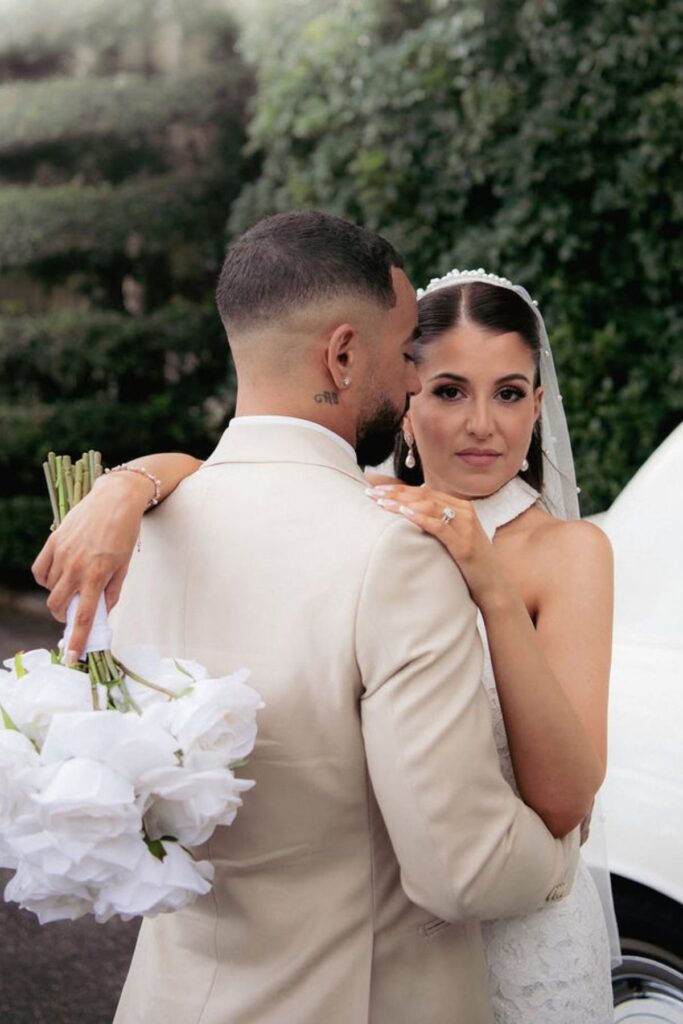
Finish your portrait session with a simple embrace that feels completely natural.
Hold each other close and forget about posing for a moment. Your photographer can step back and capture your expressions without interrupting the moment.
You can close your eyes, smile, laugh, or simply enjoy being together.
There is no need to force a particular expression because this photograph works best when you relax. Your photographer can capture several frames while you naturally respond to each other.
Try standing in a meaningful location for this final portrait.
You might choose the ceremony space, a favorite part of the venue, or a quiet outdoor area. The location can add personal meaning without distracting from the couple.
Your photographer can also capture a wider version that shows the surroundings.
Then they can move closer for a more intimate photograph. These two perspectives can give you different emotional impressions while keeping the same basic pose.
Take a few seconds after the photographer says the session is finished.
You may laugh, whisper something to each other, or simply stay close. Those final unscripted moments can sometimes become the photographs you treasure most.
Among the poses every couple should try, this one offers a natural ending to your wedding portrait session.